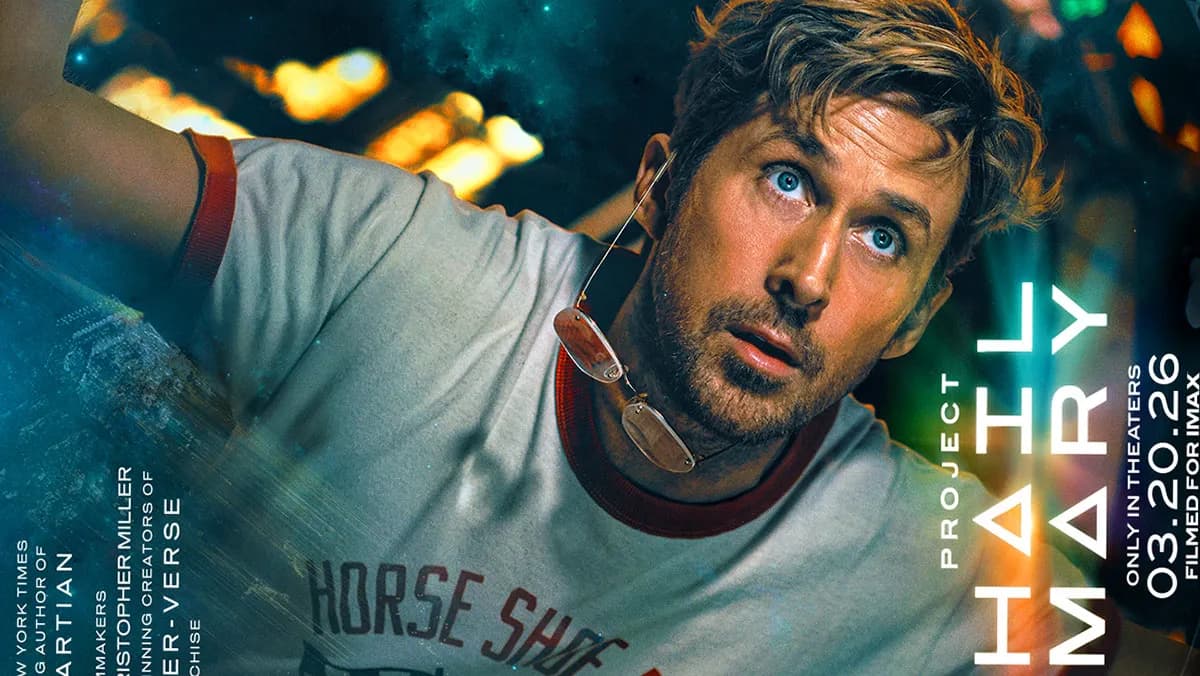

Honestly, Project Hail Mary doesn't hold a candle to Interstellar. Nolan's whole thing with spacetime folding, gravitational equations, TARS cracking jokes in the void... that's a different beast entirely. But walking out of Hail Mary, I realized my brain wasn't comparing the two. It was stuck on two things. On the drive home, still thinking. Lying in bed, still thinking.
Nothing to do with the VFX. Nothing to do with Gosling's acting. Just two choices: Stratt's choice, and Grace's choice.
This film has its own thing going on. It doesn't try too hard. It doesn't milk your emotions. But somehow it just stays with you.
The Chosen One (Who Didn't Choose)
Grace didn't volunteer.
The movie plays this pretty softly, but if you think about it, it's actually brutal. He was the only scientist who voted against the crewed mission. He didn't want to die. He made that very clear.
And then Stratt picked him.
Not because he was brave. Precisely because he was afraid to die. Stratt's logic was razor sharp: a person who fears death will do anything to survive, will exhaust every option to finish the mission and make it back.
In other words, his fear was treated as an exploitable resource.
In the end, he was sedated and loaded onto a spaceship. When he woke up, his memory was gone, two dead crewmates beside him, and he had no idea why he was there.
It reminded me of that interrogation scene in Unthinkable. That suffocating moral dilemma. Do we have the right to sacrifice one person to save the many?
Stratt's answer: yes. Without hesitation.
She could commandeer any nation's resources, bypass all due process, strap an unwilling man to a rocket. In her calculus, when 8 billion lives are on the line, one person's free will is a rounding error. It's not kidnapping. It's "a necessary cost."
I get it. But I can't fully get behind it.
Because the fatal flaw in that logic is this: it only holds up when the outcome is right. What if Grace had died on the way? What if the mission had failed? Then he'd just be another ordinary person crushed by the machinery of state. Nobody would remember him. Nobody would be held accountable.
A correct outcome doesn't retroactively justify the process.
But what makes the film interesting is that it never lets you pick a comfortable side. You'll think Stratt is cold, but you also know she might be right. You'll feel for Grace, but you also know that without him, Earth might be done.
That tension, that refusal to resolve neatly, is what gives this movie its real edge.
The Universe Is Vast. We Are Not.
There's a shot in the film that stuck with me. Grace standing at the ship's viewport, staring out at a completely alien star system. No Earth. No Sun. Not a single familiar point of reference.
In that moment I felt it viscerally: we are so incredibly small.
What do we spend our days on? Performance reviews, KPIs, mortgages, follower counts, the next funding round. On a cosmic scale, none of it even qualifies as dust. The Astrophage in the film devours stellar energy without a shred of malice. It doesn't know what humans are. It doesn't care. Whether we live or die is genuinely irrelevant to the universe.
And I think that's actually a good thing.
Because once you truly internalize how small you are, you start asking: so what actually matters?
Not your title. Not your bank balance. Not how many articles you've published or awards you've collected. These things might not even matter across a single human lifespan, let alone on a cosmic timeline.
What endures is connection.
Grace and Rocky's friendship is the part of this film that hit me hardest. A human and an alien. No shared language. Completely different survival needs. They don't even share the same sensory system. Rocky has no eyes and "sees" through sound waves. And yet they became friends.
Not because of some grand save-the-world mission. But because out there in that endless void, encountering another being who's also just trying to stay alive is, in itself, extraordinary.
It made me think about my own life. Every day it's product work, business stuff, an endless stream of small fires. But the moments that actually make me feel like the day wasn't wasted are never about how many tasks I knocked out. It's a genuine conversation with someone. It's someone pulling me up when things got rough.
So when you step back, the film is really about two fundamentally different choices.
Stratt sacrificed one real person to save an abstract humanity.
Grace abandoned an abstract mission to protect one real friend.
He chose to stay in the Tau Ceti system, to help Rocky's planet through its crisis, giving up his ticket home. Rationally, it made no sense. He was Earth's envoy. He had a mission. Earth was waiting on his data. But he chose Rocky anyway.
Who was right? I honestly don't know.
But I'm becoming more and more convinced that in the short time we have, the moments that truly make life feel worth living are rarely the grand narratives. They're the small, quiet things. The moment you look at another living being and say, "I'm not leaving you behind."
As Rocky would put it, Amaze. Amaze. Amaze.
Finding each other out here in the endless dark. That alone is amazing enough.